Inside the T800: The Body Every URKL Team Shares
The EngineAI T800 spec sheet, explained: 25 degrees of freedom, actuators peaking at 450 Nm, 360° LiDAR, solid-state battery - and what a fixed platform means for the teams competing on it.
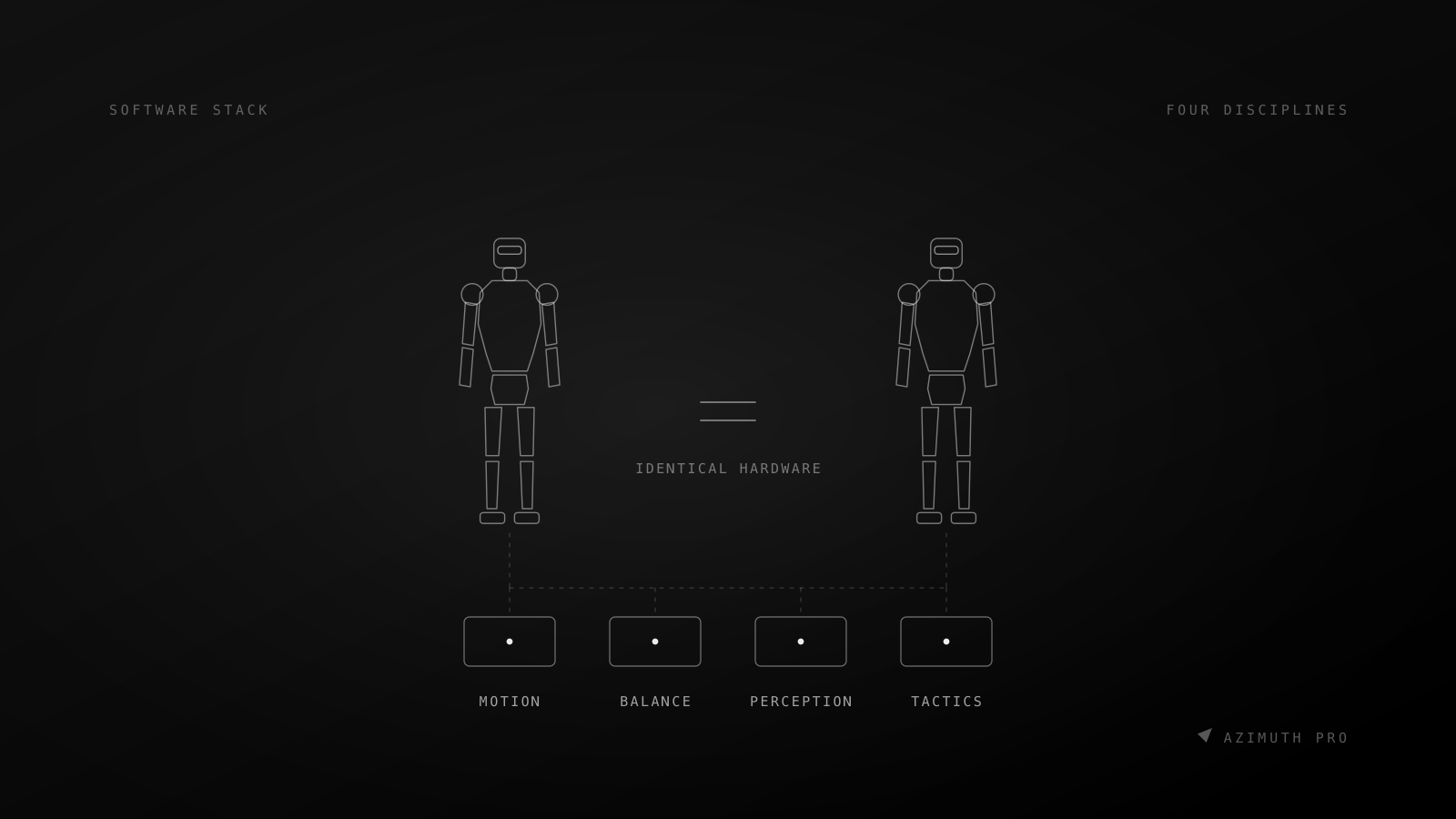
Every fight in the URKL is fought between two copies of the same machine. Same mass, same reach, same actuators, same sensors. Before we write a single word about our software, it is worth understanding the body it has to inhabit.
The spec sheet
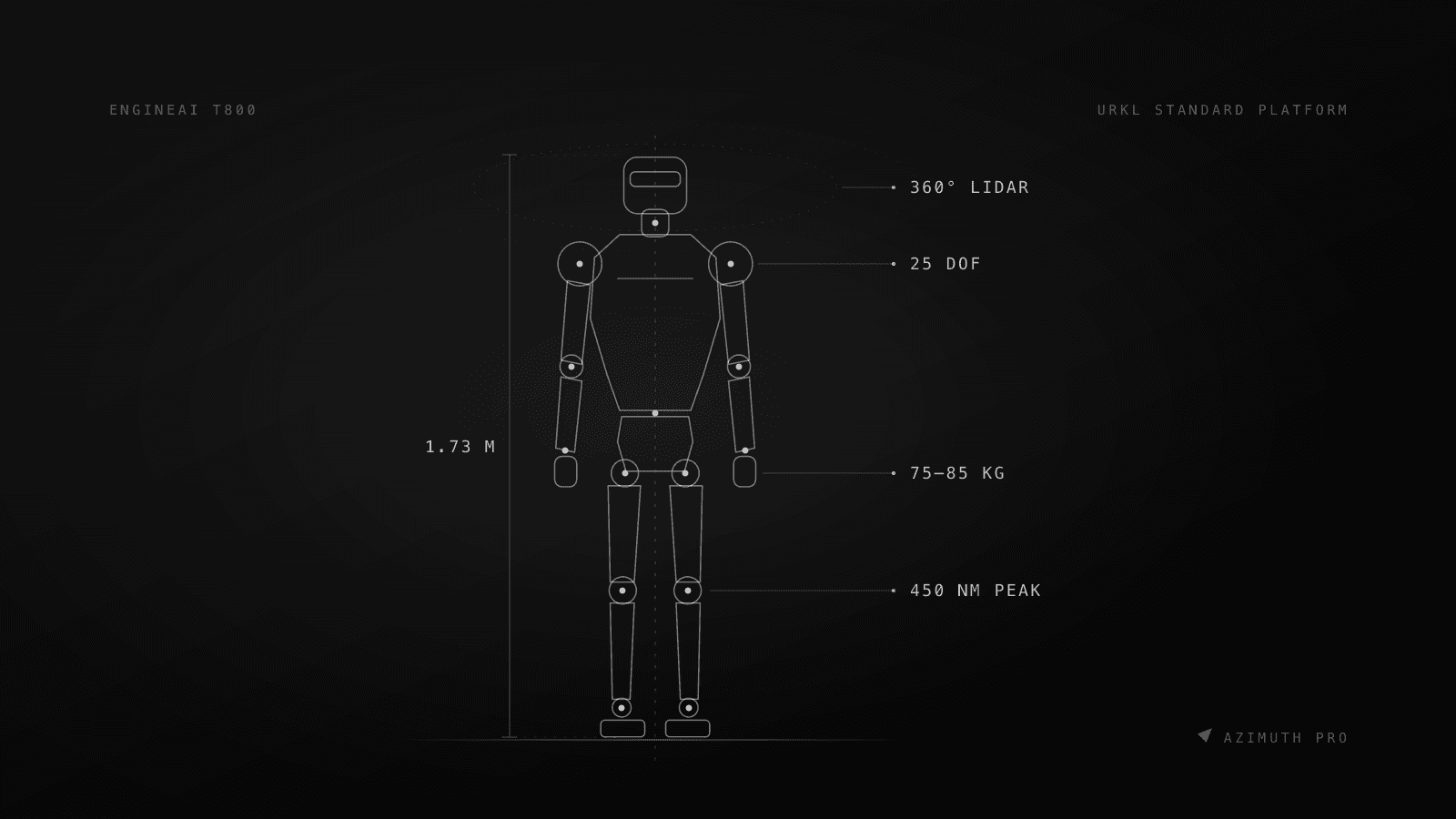
The EngineAI T800 is a full-size, general-purpose humanoid built for high-intensity physical performance:
| Feature | Specification |
|---|---|
| Height | 1.73 m |
| Weight | 75-85 kg |
| Degrees of freedom | 25 (up to 46 in higher trims) |
| Actuators | Up to 450 Nm peak torque |
| Chassis | Aviation-grade aluminum panels |
| Sensors | 360° LiDAR, stereo cameras |
| Processing | Millisecond-level environmental |
| Battery | Solid-state lithium, 4-5 h runtime |
| Cooling | Active joint cooling |
Roughly $40,500 per unit - and league rules forbid touching any of it. No structural changes, no armor, no weapons.
What 450 Nm actually means
An actuator peaking at 450 Nm in the hip is what separates a robot that walks from a robot that recovers. When 80 kilograms of aluminum takes a hit mid-stance, the controller has a few hundred milliseconds to redistribute load and place a counter-step. The torque budget decides whether that window is survivable; the software decides whether it is used.
The T800's actuators are tuned for explosive movement rather than smooth factory-floor repetition - which is exactly what makes the platform interesting. It has the capacity for a 360-degree aerial kick. Whether a machine can land one and stay upright is entirely a question of control policy.
The sensor story
The head carries a 360-degree LiDAR and stereo cameras - and the opening night of Season 1 demonstrated, memorably, that the head is optional. When Matador's sensor unit was kicked clean off, the robot kept throwing punches: its control unit and balance systems live in the torso. Degraded, blind, but upright.
That architecture is a lesson in itself. Perception is a feed, not a dependency. A machine designed for contact assumes any sensor can fail mid-exchange and keeps its balance loop running on proprioception alone.
Why a fixed platform is the right rule
BattleBots-style engineering rewards the best hardware budget. URKL's standardization rule inverts that: with the body fixed, the leaderboard measures nothing but engineering skill in software - motion control, balance, perception, tactics. A university lab and a funded team fight with identical reach and identical torque.
That is the sport we signed up for. The next post covers our side of it: the software stack that has to make this shared body ours.